


Page 26 - LCP Annual Report & Accounts 2026
P. 26
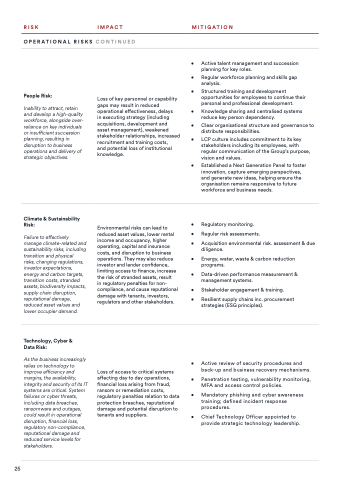
RISK IMPACT MITIGATION
   OPERATIONAL RISKS CONTINUED
   People Risk:
Inability to attract, retain and develop a high-quality workforce, alongside over- reliance on key individuals or insufficient succession planning, resulting in disruption to business operations and delivery of strategic objectives.
Climate & Sustainability Risk:
Failure to effectively manage climate-related and sustainability risks, including transition and physical
risks, changing regulations, investor expectations, energy and carbon targets, transition costs, stranded assets, biodiversity impacts, supply chain disruption, reputational damage, reduced asset values and lower occupier demand.
Technology, Cyber & Data Risk:
As the business increasingly relies on technology to improve efficiency and margins, the availability, integrity and security of its IT systems are critical. System failures or cyber threats, including data breaches, ransomware and outages, could result in operational disruption, financial loss, regulatory non-compliance, reputational damage and reduced service levels for stakeholders.
• Active talent management and succession planning for key roles.
• Regular workforce planning and skills gap analysis.
• Structured training and development
Loss of key personnel or capability opportunities for employees to continue their
gaps may result in reduced personal and professional development.
operational effectiveness, delays • Knowledge sharing and centralised systems in executing strategy (including reduce key person dependency.
acquisitions, development and • Clear organisational structure and governance to asset management), weakened distribute responsibilities.
stakeholder relationships, increased • LCP culture includes commitment to its key recruitment and training costs, stakeholders including its employees, with
and potential loss of institutional regular communication of the Group’s purpose, knowledge. vision and values.
• Established a Next Generation Panel to foster innovation, capture emerging perspectives, and generate new ideas, helping ensure the organisation remains responsive to future workforce and business needs.
   Environmental risks can lead to • reduced asset values, lower rental • income and occupancy, higher • operating, capital and insurance
costs, and disruption to business operations. They may also reduce • investor and lender confidence,
limiting access to finance, increase • the risk of stranded assets, result
in regulatory penalties for non- compliance, and cause reputational • damage with tenants, investors, • regulators and other stakeholders.
Regulatory monitoring. Regular risk assessments.
Acquisition environmental risk. assessment & due diligence.
Energy, water, waste & carbon reduction programs.
Data-driven performance measurement & management systems.
Stakeholder engagement & training.
Resilient supply chains inc. procurement strategies (ESG principles).
   Loss of access to critical systems affecting day to day operations, financial loss arising from fraud, ransom or remediation costs, regulatory penalties relation to data protection breaches, reputational damage and potential disruption to tenants and suppliers.
• Active review of security procedures and back-up and business recovery mechanisms.
• Penetration testing, vulnerability monitoring, MFA and access control policies.
• Mandatory phishing and cyber awareness training; defined incident response procedures.
• Chief Technology Officer appointed to provide strategic technology leadership.
   25


